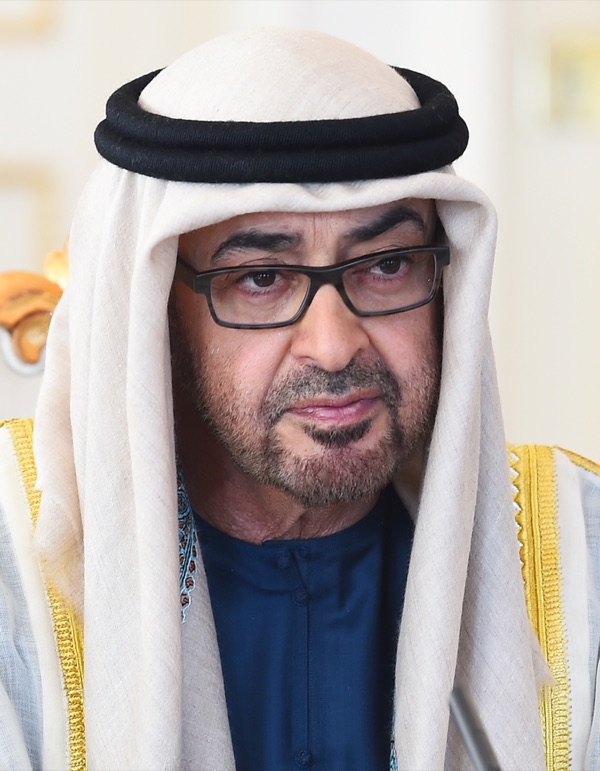
When Mohamed bin Zayed Al Nahyan was elected president of the United Arab Emirates on 14 May 2022 — the day after his brother Khalifa’s death elevated him to Ruler of Abu Dhabi — he stepped into a role he had effectively been performing for eight years. Since Khalifa suffered a stroke in January 2014, MBZ, as he is universally known, had been the operational force behind the emirate. The formal crowning was almost a formality. The power had long since settled in his hands.
Born on 11 March 1961 in Al Ain, the inland oasis city that his father Sheikh Zayed bin Sultan Al Nahyan helped transform into an emblem of Emirati identity, Mohamed grew up as one of thirty children of the UAE’s founding father. He trained at the Royal Military Academy Sandhurst, became Crown Prince of Abu Dhabi in 2004, and spent the two decades between then and his formal ascension quietly engineering the emirate’s transformation into a global financial and strategic hub. His son Khaled was appointed Crown Prince in March 2023, setting the succession in place.
Three Piles of Money, Only One Is His
Here is where the famous wealth figures get slippery. When headlines place MBZ among the world’s richest individuals — estimates float between $150 billion and $300 billion, sometimes higher — they are, almost without exception, blending three entirely distinct categories of money.
The largest pile is sovereign wealth. The Abu Dhabi Investment Authority holds an estimated $1.1 trillion in assets under management: global equities, private equity, infrastructure, real estate. ADIA was created in 1976 to invest Abu Dhabi’s oil surpluses on behalf of the government. MBZ’s brother Hamed serves as its managing director; another brother, Tahnoun, chairs it. It is state money managed by family members — not family money. Conflating it with personal wealth is the same error as saying the U.S. Treasury Secretary is personally worth $36 trillion.
The second pile is semi-commercial. Mubadala Investment Company, where MBZ long held oversight, functions as Abu Dhabi’s strategic investment arm — backing chipmakers, aerospace, renewables, and global tech funds. It manages roughly $300 billion. ADQ, a newer Abu Dhabi sovereign vehicle focused on infrastructure and food security, holds further hundreds of billions. Both are instruments of state economic policy. They happen to be controlled by members of the ruling family. That is not the same as belonging to the family.
The third pile — the personal one — is genuinely opaque. Unlike the British royal family, whose assets, estates, and income streams are subject to some degree of parliamentary scrutiny, or Gulf peers whose real-estate holdings surface in transaction records, MBZ’s direct personal holdings exist in a near-total information vacuum. What is publicly documented: the Al Nahyan family as a dynasty controls substantial real property across Abu Dhabi, historic land grants tied to the emirate’s founding, and stakes in privately held ventures. The specific dollar figure attributable to Mohamed personally is not known.
The Man Behind the Money Machine
What is better documented is how actively he has shaped the economy that generates all of it. During his years as Abu Dhabi’s de facto ruler, MBZ drove the diversification strategy that reduced the emirate’s dependence on oil revenues, oversaw the Mubadala investments that turned Abu Dhabi into a preferred destination for sovereign co-investment, and positioned the UAE as a neutral diplomatic player capable of warming relations with Israel (the Abraham Accords, 2020) while maintaining pragmatic ties with adversaries of Washington. These moves were simultaneously geopolitical and financial: a stable, globally connected emirate protects the value of everything the ruling family stewards.
He chairs the Abu Dhabi National Oil Company and previously chaired the Supreme Council for Financial and Economic Affairs — roles that gave him direct visibility into every significant capital flow touching the emirate. The suggestion that he is merely a trustee of state assets, with no personal financial benefit, strains credulity. But so does the suggestion that any individual personally owns a trillion dollars.
What We Actually Know
The blended $150–$300 billion figure that circulates in wealth rankings reflects a methodology that most serious analysts treat with skepticism: it assigns a fraction of sovereign fund assets to the monarch as if they were personal property. The underlying logic — that a ruler who controls a fund effectively owns it — has some political truth and essentially no financial or legal truth.
MBZ’s real personal fortune, by any rigorous accounting, has never been independently verified, itemized, or disclosed. It may be large by any ordinary measure. In the company of a $1.1 trillion sovereign fund, almost anything looks small.
How knowable is his true personal wealth? With no public disclosure requirements, no independent auditors, and a family empire deliberately structured to blur the line between state and dynasty, the honest answer is: it isn’t.