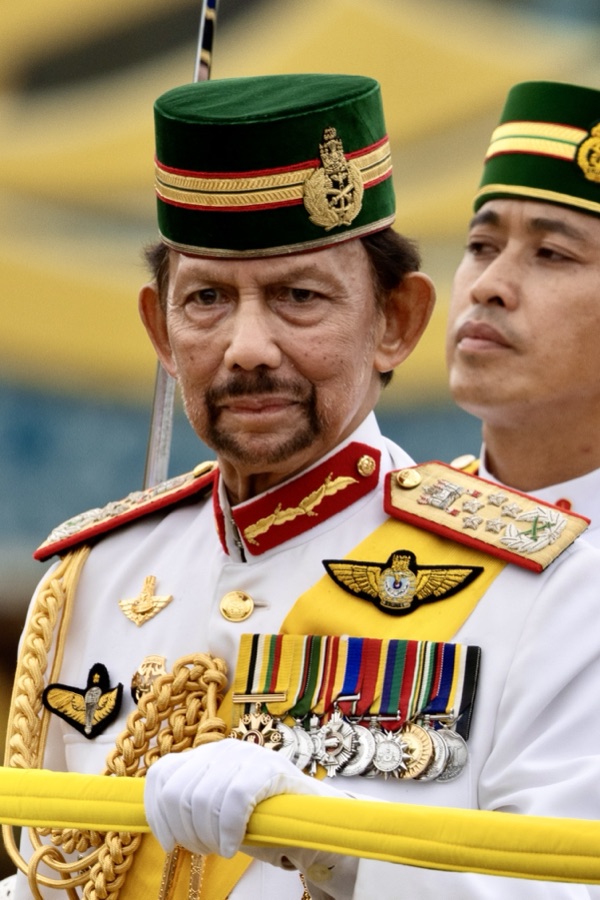
He has been Sultan of Brunei for longer than most of his subjects have been alive. Hassanal Bolkiah took the throne on 5 October 1967 at twenty-one years old, and as of today holds the distinction of being the world’s longest-reigning current monarch and longest-serving current head of state. Over nearly six decades, he has accumulated titles the way lesser rulers accumulate ceremonial swords: Sultan, Prime Minister, Minister of Defence, Minister of Finance. In an absolute monarchy where the constitution vests full executive authority in a single person, those titles are not honorifics. They are job descriptions.
The Palace Problem
Any reckoning with Hassanal Bolkiah’s wealth begins with the building he sleeps in, because nothing else quite illustrates the difficulty of separating the man from the state. Istana Nurul Iman — completed in 1984 at a construction cost reported between $1.4 billion and $3 billion depending on which estimate you trust — covers roughly 200,000 square metres along the Brunei River outside Bandar Seri Begawan. Guinness World Records recognises it as the world’s largest residential palace: 1,788 rooms, 257 bathrooms, a banquet hall that seats 5,000, a mosque for 1,500 worshippers, five swimming pools, and 110 garages housing approximately 7,000 vehicles collectively valued at around $5 billion.
That last figure raises an obvious question. Whose cars are those? Formally, the palace and its contents belong to the sultanate. Practically, one family lives there. In an absolute petro-monarchy, that distinction does a lot of quiet work.
Oil, BIA, and the Brother Problem
Brunei’s wealth is a hydrocarbon story. The country produces roughly 100,000 barrels of oil per day from reserves that have been slowly depleting since their 1970s peak, and the government — meaning the Sultan — has spent decades attempting to diversify through the Brunei Investment Agency, the sovereign wealth fund he oversees as Finance Minister.
The BIA became infamous during the 1990s when it emerged that somewhere in the vicinity of $40 billion in transfers had flowed through its accounts between 1983 and 1998, with roughly $14.8 billion traceable to accounts held by Prince Jefri Bolkiah, the Sultan’s younger brother. Jefri’s Amedeo Development Corporation — a sprawling empire that at various points operated hotels, airlines, and construction projects across multiple continents — collapsed in July 1998 carrying an estimated $10 billion in debt. The resulting legal proceedings, settled largely out of court, dragged on for years and produced lurid court filings about spending habits that made the Palace of Versailles look frugal.
The Sultan eventually reached a settlement with Jefri and recovered some assets. How much, and through what accounting, has never been fully disclosed. The episode is instructive not because it revealed corruption in any simple sense, but because it demonstrated how porous the boundary between state treasury and royal household had become. When $40 billion can move through a sovereign wealth fund with limited external oversight, the question of what the Sultan personally “owns” versus what the state controls on his behalf becomes largely academic.
What the Number Actually Means
Estimates of Hassanal Bolkiah’s net worth have ranged from roughly $20 billion to $40 billion over the past two decades, with some sources pushing higher. These figures are essentially informed guesses dressed in the language of precision. No public audit of royal assets exists. No independent valuation of palace holdings, private aircraft, or the remaining car collection has been published. Brunei is not required to file disclosure documents with any external body, and the Sultan has never invited scrutiny.
What we can say with confidence: Brunei’s annual government revenues run to several billion dollars, and the Sultan’s family has had preferential access to those flows for generations. The Amedeo collapse was a contraction, not an extinction. The palace still stands. The cars are still there. The oil is still flowing, if more slowly.
Our working figure of $20 billion to $30 billion reflects that context: large enough to be real, soft enough to be honest. The blended confidence is low, not because the Sultan is poor but because the numbers were never meant to be known.
Absolute monarchies do not publish balance sheets. That is, in some respects, the entire point.