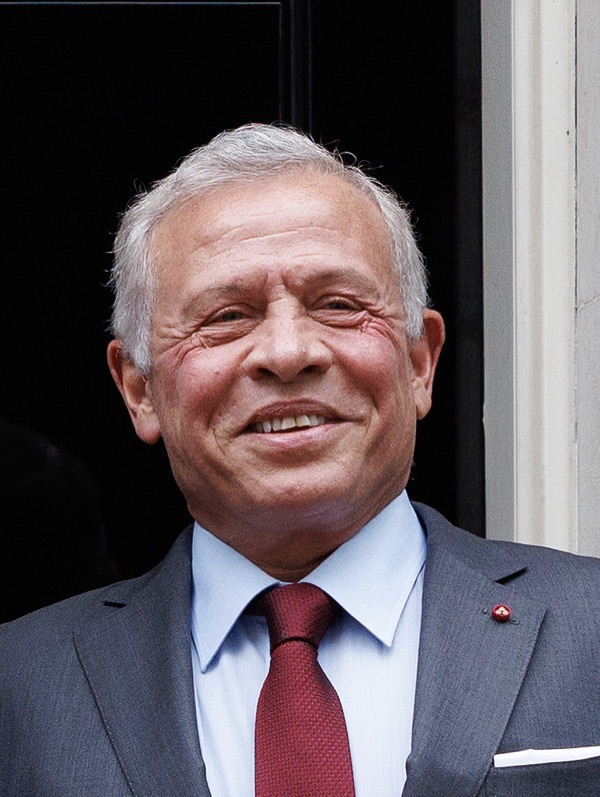
Soldier Before King
Abdullah bin Al-Hussein did not expect the crown. Born in Amman on January 30, 1962, he spent the better part of three decades building a military career rather than a political one. He passed through the Royal Military Academy Sandhurst, rode with the 13th/18th Royal Hussars in Britain and West Germany, picked up a year at Oxford studying Middle Eastern affairs, and later earned a diploma at Georgetown’s School of Foreign Service. By the mid-1990s he was commanding Jordan’s Special Forces; by 1998 he held the rank of major general. He was named Crown Prince just five weeks before his father, King Hussein, died of lymphoma. On February 7, 1999, at thirty-seven, he became king.
The soldiers-make-steady-rulers theory has some backing here. Abdullah’s Jordan has stayed off the worst lists — not at war with its neighbors, not in domestic free-fall — while sitting in one of the most combustible neighborhoods on earth. That takes a certain kind of cold management. Whether it takes $100 million in California beachfront is a separate question.
The Pandora Papers Number
In October 2021, the International Consortium of Investigative Journalists released the Pandora Papers, a trove of nearly 12 million leaked financial documents. Among the findings: King Abdullah II had spent more than $100 million acquiring luxury properties across the United States and United Kingdom through a web of offshore companies. The disclosed addresses included homes in Malibu, Washington D.C., London, and Ascot in Berkshire — the last a quiet English village best known for horse racing and weekend retreats for the well-connected.
The offshore structure was not, in itself, illegal. Wealthy individuals routinely use holding companies to buy real estate, for privacy, tax efficiency, or both. What made the disclosure politically uncomfortable was the context. Jordan carries chronic government debt, runs unemployment rates that push a significant share of its young population to the sidelines, and depends heavily on foreign aid — from the United States, Gulf states, and international lenders — to keep its budget above water. The optics of a head of state accumulating a quietly curated portfolio of foreign luxury homes while his government accepts aid transfers did not land softly.
Abdullah’s office did not dispute the property holdings but pushed back on the framing, arguing that personal assets are separate from state finances and that the offshore vehicles were used for legitimate security and privacy reasons. That is a defensible position in law. It is a harder sell as a matter of political optics, and the Pandora Papers moment confirmed what critics in Jordan had long suspected: the palace’s finances, officially undisclosed, run to a scale that sits uneasily next to the national ledger.
What We Can Actually Estimate
Here is where honesty requires some restraint. The $100 million figure is a floor, not a ceiling — it represents what appeared in the leaked documents, specifically the property portfolio. It says nothing about bank accounts, investment holdings, stakes in Jordanian enterprises, or assets held in structures that were not captured in the leak.
The Hashemite monarchy does not publish a balance sheet. Jordan has no constitutional provision requiring royal financial disclosure. Comparative benchmarks — what Gulf monarchs or European royals hold — don’t map cleanly onto a country of Jordan’s size and resource base.
Analysts and journalists covering the Gulf and Levant have offered informal estimates of Abdullah’s total personal wealth in the range of several hundred million dollars, with some reaching toward a billion. These figures rely on the Pandora Papers anchor, extrapolation from known assets, and educated inference about royal allowances and business relationships accumulated over a quarter-century reign. They should be read as order-of-magnitude estimates, not audited figures.
Editorial read: $750M–$1B, basis Personal, confidence Low.
The honest answer is that outside of another major leak, Abdullah II’s true net worth is not knowable — the $100 million in luxury homes is the only hard data point the public has ever had, and it arrived by accident.
Jordan’s palace has never voluntarily disclosed royal finances, and short of a second major document leak, that is unlikely to change.