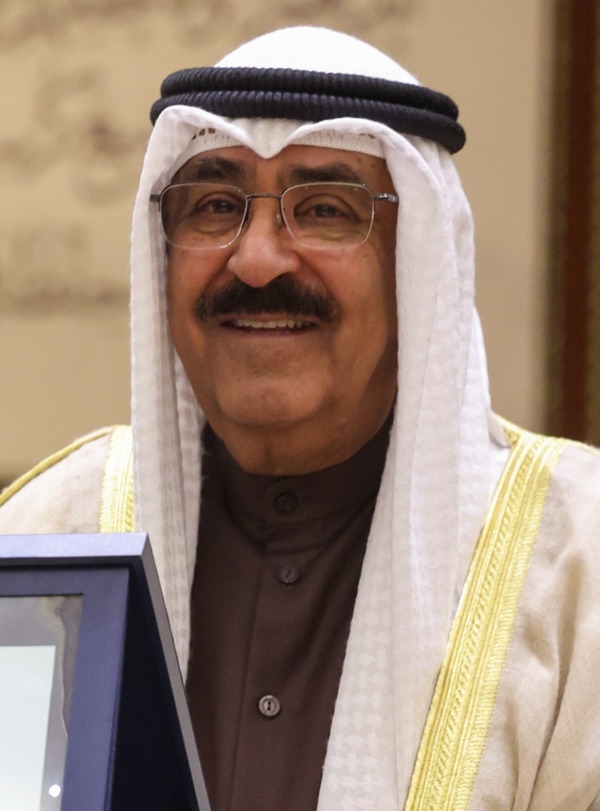
When Mishal Al-Ahmad Al-Jaber Al-Sabah became Emir of Kuwait on 16 December 2023 — following the death of his half-brother Nawaf — he was already 83 years old. He had spent decades waiting in the wings, most recently as the world’s oldest crown prince. What he inherited was not merely a title but stewardship of a compact Gulf state that, through discipline and oil, built the planet’s first sovereign wealth fund and has kept it running for over seventy years.
The personal fortune question, which animates so many royal profiles, nearly dissolves in Kuwait’s case. There is no reliable public figure for Mishal’s private assets, and that is not an oversight — it is a structural feature of how the Al Sabah ruling family and the Kuwaiti state are intertwined.
A Career in the Shadows
Before he was a monarch, Mishal was a spy. He graduated from Hendon Police College in London in 1960, joined the Ministry of Interior, and by 1967 was running Kuwait’s state security service — a post he held for thirteen years. It is the kind of career that leaves few public financial footprints. In 2004 he was named deputy chief of the Kuwait National Guard at ministerial rank, another institution whose internal economics are not disclosed. Only in October 2020, at age 80, did he become Crown Prince.
The arc is that of a man who operated inside state power rather than alongside it, accumulating influence rather than a diversified investment portfolio visible to outsiders. If he has significant private holdings — real estate, shareholdings, offshore accounts — they have not surfaced in any credible public record.
The Fund That Dwarfs Everything
The more interesting money story in Kuwait has always been institutional. In February 1953 — before the modern state even had a constitution — Kuwait established what would become the Kuwait Investment Authority (KIA), channeling oil revenues into a professionally managed fund. Today the KIA oversees approximately $1.07 trillion in assets, making it the world’s fifth-largest sovereign wealth fund and, by some margin, the oldest.
Two pools sit inside the KIA. The General Reserve Fund handles day-to-day fiscal smoothing, covering budget shortfalls when oil prices crater. The Future Generations Fund is the more philosophically ambitious vehicle: it receives 15 percent of Kuwait’s annual oil revenues automatically, compounding across decades as a bequest to citizens who have not yet been born. That structure — mandatory, constitutionally embedded, generationally oriented — is why Kuwait survived the 2014 oil-price crash without the fiscal crisis that hit some of its neighbors.
The Al Sabah family governs Kuwait, and the Emir chairs or influences the bodies that oversee the KIA. That relationship is better described as custodial than proprietary: the fund is legally state property, not dynastic wealth. But the family’s political legitimacy is inseparable from the fund’s existence, and the fund’s continued growth makes the Emir’s position more secure. The financial and political are fused in a way that makes any clean separation of “family money” from “national money” somewhat artificial.
What the Numbers Cannot Tell You
Kuwait is a constitutional emirate with a parliament that has, on occasion, forced cabinet resignations and challenged government spending. That accountability structure — rare in the Gulf — means the KIA’s books receive more scrutiny than in purely absolutist systems, even if full transparency remains elusive.
What analysts and journalists consistently find when they go looking for the Emir’s personal balance sheet is an absence — not a hidden trove, but a genuine gap in available data. Gulf monarchies do not file personal financial disclosures. Estimates of “royal family wealth” from financial media typically blend state assets, family trusts, and outright speculation in ways that produce impressively large numbers with vanishingly small evidentiary bases.
Mishal spent his career in security and intelligence, not commerce. He ascended to the throne at an age when most people have long since retired. The reasonable inference is that his personal wealth is significant by any ordinary standard — access to state resources over decades rarely leaves a person poor — but modest relative to the sovereign fund he now nominally oversees.
Editorial read: Sovereign-funded; personal unclear. Basis: blended. Confidence: very low.
The Emir of Kuwait may be the hardest profile in this series to put a number on precisely because the state’s wealth is so transparent and his own so thoroughly undisclosed.