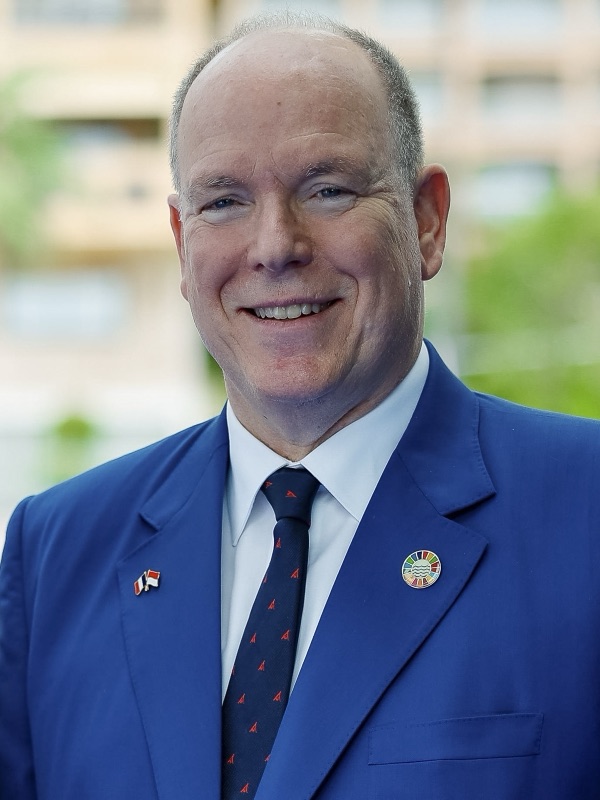
There are monarchies that sit atop sovereign wealth funds measured in the trillions, and then there is Monaco — two square kilometers of Mediterranean real estate where the sovereign’s personal fortune is distinctly more visible, and considerably more interesting, than the principality’s GDP would suggest.
Prince Albert II has ruled since April 2005, when his father Rainier III — himself a titan of mid-century celebrity statecraft — died after five decades on the throne. Albert was born in the palace he now runs on 14 March 1958, studied political science at Amherst College, spent time in the French Navy, and became, when his moment arrived, one of the more environmentally active heads of state on the planet. He has visited both poles. He was the first sitting monarch to test positive for COVID-19. He is, by conventional measures, worth roughly a billion dollars — though the word “conventional” does almost no work in a place where the palace is also the government and the casino underwrites the national budget.
The SBM Stake: Where Private and Public Blur
The centrepiece of the Grimaldi wealth story is the family’s shareholding in Société des Bains de Mer, the company that operates the Casino de Monte-Carlo, the Hôtel de Paris, the Opéra de Monte-Carlo, and a constellation of restaurants, beach clubs, and spa properties. SBM, founded in 1863 and traded on Euronext Paris under the ticker BAIN, is Monaco’s single largest employer with more than 4,400 staff and 52 of its 58 properties clustered inside the principality.
Here is where precision becomes elusive: the Government of Monaco holds approximately 59 percent of SBM — and because Albert is, constitutionally, the state, the line between his personal balance sheet and the national one is genuinely porous. What is documentable is that Albert holds SBM shares in his own right, alongside the government’s controlling position. Those shares trade publicly. The casino does not belong to Albert the way a private company might; it belongs, in a layered and historically tangled way, to the institution he embodies. For wealth-tracking purposes, that blurring is the story, not a caveat to be disposed of.
Real Estate, Cars, and the Stamp Room
Beyond SBM, the Grimaldi asset base is more straightforwardly personal. The Prince’s Palace itself — a fortified structure occupying the Rock of Monaco since the thirteenth century — is a sovereign residence and a functioning museum; its valuation is academic. Albert also maintains private homes in La Turbie, in the hills above Monaco, and at a property in Marchais. In 2016 he purchased the Philadelphia childhood home of his mother, Princess Grace, preserving it as a private heritage acquisition rather than a commercial one.
The collections are real and known. Albert is a devoted philatelist — Monaco has issued celebrated postage stamps since 1885 and maintains a dedicated museum — and his family’s stamp archive represents decades of accumulation with genuine collector value, though no public appraisal exists. The vehicle collection skews conspicuously green: a BMW Hydrogen 7, hybrid Lexuses, a Toyota Prius. The Dassault Falcon 7X in the fleet is rather less carbon-neutral, but it is at least honest.
The Dynasty’s Long Game
The House of Grimaldi has held Monaco, with some interruptions, since 1297 — a tenure that makes most European royal houses look newly arrived. That longevity is itself an asset: the brand recognition that keeps Monte Carlo operating as a global luxury destination, that fills the hotel suites and the baccarat tables, rests substantially on the story of an unbroken line and a rock by the sea. Albert married South African swimmer Charlene Wittstock in 2011; their twins, Jacques and Gabriella, were born in 2014, with Jacques designated heir apparent.
The 2010 estimate of roughly $1 billion in personal wealth has not been materially revised upward in public reporting, which either reflects genuine stability or the opacity that small-state sovereignty affords.
Monaco’s accounts are not Switzerland’s accounts. The Grimaldi fortune is more knowable than most — SBM is publicly listed, Albert’s philanthropy is well-documented, and the principality is tiny enough that major transactions surface — but the constitutional fusion of prince and state means that a precise personal net worth will always carry an asterisk the size of a casino.