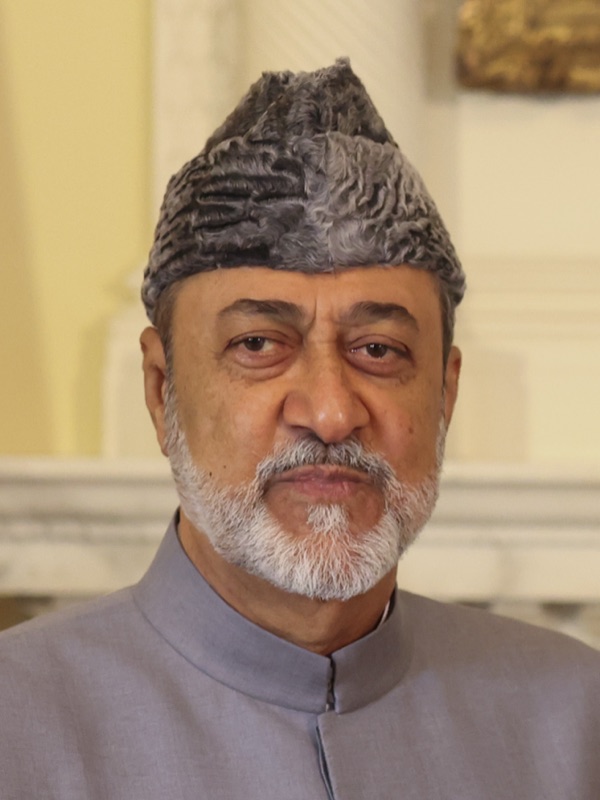
A Succession Nobody Planned For
When Sultan Qaboos bin Said died on 10 January 2020, Oman faced a constitutional puzzle that most Gulf monarchies would have found alarming. Qaboos had ruled for nearly half a century, modernised a medieval sultanate almost single-handedly, and declined to name a successor or produce an heir. His instructions — sealed in a letter, opened only after his death — pointed to his first cousin Haitham bin Tariq Al Said.
Haitham was not a surprise from nowhere. Born in Muscat on 11 October 1955, educated at Brummana High School in Lebanon and then Oxford’s Foreign Service Programme, he had spent his career doing exactly the kind of work that does not attract international headlines: decades at the Ministry of Foreign Affairs, then eighteen years as Minister of Heritage and Culture, and most recently as chairman of the committee drafting Oman Vision 2040 — the country’s long-range blueprint for economic diversification away from oil. He was, in short, the man the system had prepared for a role adjacent to power rather than at its centre. Then the envelope was opened.
Haitham was proclaimed sultan the day after Qaboos died. He moved swiftly in ways that suggested a man who had thought carefully about the job even without expecting to hold it. He established a Crown Prince for the first time in Omani history, naming his son Theyazin — ending the deliberate ambiguity that had let Qaboos govern as the sole, irreplaceable focal point of the state.
The Qaboos Problem: When the Sultan Is the Budget
To understand Sultan Haitham’s finances — or the near-impossibility of isolating them — you need to understand what Qaboos built. For almost fifty years, the distinction between the sultan’s personal wealth and Oman’s oil revenues was, in practice, an accounting formality. Oil money flowed into the state; the state was Qaboos; Qaboos was the state. The palaces, the military, the infrastructure buildout that transformed Oman from one of the poorest countries in the Arab world into a functioning modern economy — all of it moved through a system in which the ruler’s preferences and the national budget were not easily separable documents.
This is not unusual in the Gulf. But Oman’s version was especially pronounced because Qaboos had no family power-sharing arrangement to speak of. There was no Crown Prince to satisfy, no rival branch of the dynasty to balance. The result was extraordinary centralisation and, for outside observers, an almost total opacity regarding anything that could be called personal royal wealth.
When oil prices fell sharply in the mid-2010s, the cracks in this model became fiscal cracks. Oman ran budget deficits, borrowed internationally, and arrived at 2020 with both a new sultan and a public finance problem that demanded structural change.
Haitham’s Careful Separation Project
The reforms Haitham has pursued since accession are, among other things, an attempt to introduce distinctions that Qaboos never needed to make. The Oman Investment Authority — created by royal decree in 2020, the same year he took power — consolidated the country’s sovereign wealth vehicles into a single entity reporting to the Council of Ministers rather than sitting inside the sultanate’s personal apparatus. It is a structural signal: national capital is being given institutional form separate from the ruling family.
He introduced VAT in 2021, the first broad consumption tax in Oman’s modern history — fiscally unremarkable by global standards, but symbolically significant in a country whose rulers had long used hydrocarbon revenue to keep the social contract tax-free. A budget surplus arrived in 2022 as oil prices recovered. A personal income tax is proposed for 2028. The picture is of a ruler governing within constraints, not above them.
None of this tells us what Haitham is personally worth. The Al Said family’s private holdings — real estate, investments, assets accumulated across Qaboos’s five decades — are not disclosed anywhere. The OIA’s assets run to the tens of billions, but that is state money with institutional governance, not a family fund. The honest answer is that no clean personal figure exists because, until very recently, no one in Oman needed to draw that line.
The story of Sultan Haitham’s wealth is, in large part, the story of a country deciding, for the first time, that the line might matter.
Editorial read: Sovereign-funded; opaque | Basis: Blended | Confidence: Very low. Any figure attached to Haitham’s name would reflect national oil patrimony more than personal holdings, and no reliable personal disclosure exists.