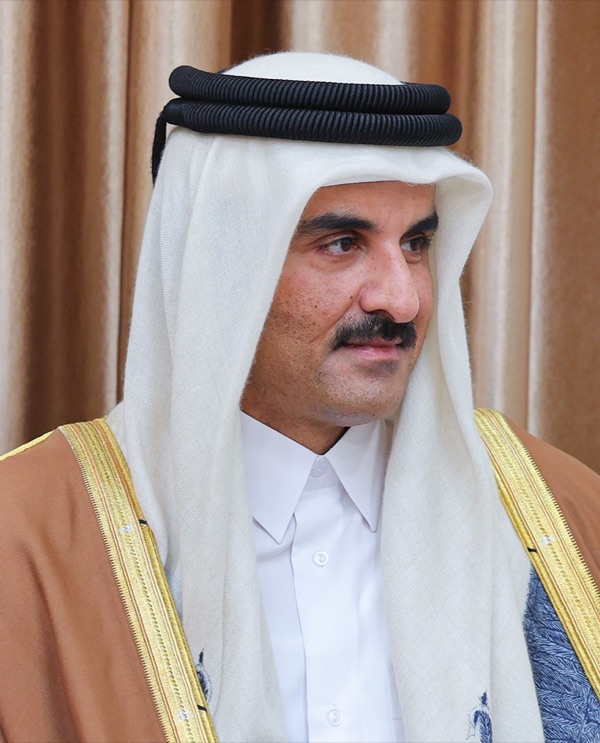
A Throne Handed Over on Television
On 25 June 2013, Hamad bin Khalifa Al Thani sat before cameras, read a brief speech, and made his forty-something son the ruler of Qatar. No coup, no funeral, no constitutional crisis — just a tidy transfer that caught most of the world slightly off-guard. Tamim bin Hamad Al Thani was thirty-two years old, Sandhurst-trained, and now responsible for a small peninsula whose hydrocarbon reserves have been quietly reshaping global financial geography for two decades.
He grew up between Doha and English boarding schools — Sherborne, then Harrow — graduating from the Royal Military Academy in 1998 with the kind of CV that reads like a checklist for dynastic succession. He speaks Arabic, English, and French. He plays badminton competitively. He has thirteen children across three marriages. He owns Paris Saint-Germain Football Club, depending on how you define “owns” — which, in Qatar’s case, is always the interesting question.
The QIA Is Not His Piggy Bank (Except When It Kind Of Is)
Here is where the accounting gets philosophical. The Qatar Investment Authority manages somewhere north of $600 billion in assets, a figure that has ballooned as the country’s liquefied natural gas exports turned tiny Qatar into one of the wealthiest nations per capita on earth. The QIA was founded in 2005 by Tamim’s father specifically to park the surplus from that gas bonanza into global assets — a sovereign insurance policy against the day the wells run quieter.
On paper the QIA is state money. Its formal chairman is a cousin; its CEO is a technocrat. But the fund was explicitly designed to be managed in close coordination with the ruling family, and analysts who track Gulf sovereign wealth structures note that governance transparency at the QIA is, charitably, a work in progress. When decisions materialize, they tend to reflect the emir’s priorities.
Those priorities have produced a trophy case that would embarrass most private equity firms. The QIA owns Harrods outright — the entire London institution, floor by floor, Egyptian escalator and all. It holds roughly 95 percent of The Shard, the glass spike that now defines the south bank of the Thames. It controls about 20 percent of Heathrow Airport and is one of Volkswagen’s largest shareholders. Canary Wharf, Manhattan West, stakes in Glencore, Sainsbury’s, Lagardère — the portfolio reads like a particularly ambitious Monopoly variant played with real currency.
Separate from but adjacent to QIA sits Oryx Qatar Sports Investments, the vehicle Tamim personally founded in 2005 that eventually acquired Paris Saint-Germain. PSG is not a QIA asset in the formal sense; it is closer to the personal or quasi-personal column of the ledger, which is exactly why drawing clean lines around Tamim’s wealth is so difficult.
What the Numbers Actually Mean
Any figure you have seen attached to Tamim’s name — and they range from the low hundreds of billions to numbers that require fresh zeroes — is almost entirely a function of which pool you are counting. Strip out the QIA and you are left with the personal and family assets of the Al Thani dynasty: real estate across Doha and Europe, the PSG stake, miscellaneous investments. Those are substantial by any sane measure but are genuinely opaque, as they flow through family structures that do not publish balance sheets.
Add back the QIA and the blended figure enters the $200 billion to $335 billion conversation that wealth trackers occasionally publish, with the caveat that this is national patrimony attributed to a ruler, not personal liquid net worth. Add the latest AUM estimates and the number climbs further, though the underlying governance ambiguity climbs with it.
Qatar’s gas wealth is the engine behind all of it. The country sits atop the world’s largest single natural gas field — shared with Iran — and its LNG infrastructure has made it indispensable to European energy markets in ways that became vivid after 2022. The more geopolitically essential Qatar becomes, the more the QIA’s capital compounds, and the more the distinction between the emir’s interests and Qatar’s interests looks like a useful legal fiction maintained by everyone involved.
Tamim’s actual personal fortune is unknowable. The blended number is very large and almost certainly more the nation’s than his. That is, arguably, the whole point.